Transporting Designer Genes From Planet Caravan
...after a serious marathon game of Merchants Of Venus over the weekend that lasted nearly five hours for a standard 30 rounds, I have been thinking about what it might be like to break out one of the bigger games on a table made for gaming. Even having played Small World earlier in the day, the standard dining table just barely contains everything comfortably. We also tried to run a campaign of The Legend Of Drizzt but there are containment issues there as well. If we were ever able to realize a full session of Civilization with 5 to 6 players, the need for a much larger playing surface arises.

If one does a search for gaming tables online, you either get shots of ultra expensive billiards tables or at-home craps tables that cost the equivalent of a brand new hatchback. Despite the popularity of fantasy gaming, video games and miniatures, the mainstream idea of a gaming table still evokes smokey back rooms and paychecks gambled away frivolously. The best case scenario for the frugal strategy gamer is to buy a fairly affordable fold-out poker table from Sears. Still running at nearly $200, it is a far cry from a $6,000 investment from American Sales for a craps table for tabletop gaming.
However, amidst my search, I stumbled upon a blog by a veteran tabletop gamer who also happens to be a father and amateur woodworker (I believe). Between his blog and a forum I linked to on BGG.com, I found a number of resourceful types who had built and shared evidence of their tabletop creations that appeared incredibly sturdy, amply sized to handle anything from Monopoly to Warhammer 40,000 and made very inexpensively. For an average of $200, these people were building massive tables for their hobbies for the price of a Target kitchen set.
As I get older, I have developed a small-but-growing interest in trying to learn some simple woodworking. A former girlfriend of mine had a very talented father who made furniture in his spare time and since then, I have been curious as to how to learn the craft. With my growing visions of not only having ample game space on a table but also someday hosting sizable get-togethers where several friends and/or couples congregate to eat, drink and battle one another in rounds of 7 Wonders, Power Grid or Talisman together, I am thinking that learning on the job of sorts is in my future.
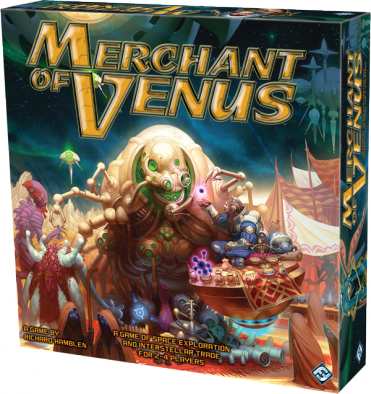 ...as I mentioned Merchants Of Venus above, it has been some time since I've had a virgin run through such a massive game in terms of time commitment. When I first bought Talisman a few years back, my initial game lasted 6 hours over two nights. I was instantly in love, having found a tabletop game requiring social interaction that felt like a PC RPG. Add in the various expansions and you could play for an entire day. The same thing occurs in a 3 player or higher session of the Civilization board game. I have chatted with a friend or two that prefers the more compact tabletop experience, but I am a huge fan of a long grind towards victory. It feels like a well-earned slog.
As I slowly try to introduce the idea of designer gaming to new people just by talking about it, I have a few go-to games in mind to start. Whether being intimidated or turned off to "nerd hobbies", most new players are not going to get enthralled by a four-hour tabletop campaign of Talisman with the added bonus of the Reaper attempting to kill all players throughout the quest.
As an introductory, I find it easier to introduce someone to something faster paced like Dominion, Carcassonne or Marvel's Legendary. Those games are a good introduction to the more strategic combat and decision options while wrapping in under one hour. That said, I still love a good evening evaporating away within a game that can be played alongside the Star Wars trilogy, possibly still going strong after Return Of The Jedi ends. Merchants Of Venus is the new king of this realm.
Many games suffer from fatigue after the base game has been run through a few times. You've completed all of the side quests, defeated this-or-that monster or villain a million times and it becomes too formulaic if you play too often. Even as much as I worship at the altar of Talisman, I find that the multiple expansions will give it added life in the years added. Merchants Of Venus, as a base game alone, feels so epic in scale that no amount of play throughs can weaken what makes it such a difficult game to navigate in terms of quest completion.

In the outset, each player is given an initial quest to complete in 30 rounds. While you can buy more quests at the home base, once you figure out that it can take 5 rounds just to make it from one planet to the next, you may never even complete your initial quest by the game's end. The core of Merchants Of Venus is essentially a basic buying/selling economics component in outer space. From that simple idea comes trying to manage changing markets, getting goods to where they can be sold in a timely fashion, knowing your closest destination is still at the other end of the board all while trying to avoid asteroid belts, supernovas, inconvenient warp points and space pirates.
There is a constant atmosphere of not feeling like there is enough time to do what needs to be done. There is structure, but the game throws so many obstacles in your path at almost all times that you never feel like a plan goes smoothly. As the game progresses, you have your Plan A while you can find yourself spending the other players' turns quietly developing secondary plans in case your initial plan falls through. It is these complications and headaches that has me currently wanting to shout from the rooftops with a bullhorn that no household is complete without a copy of this reprinted masterpiece in their home.
If one does a search for gaming tables online, you either get shots of ultra expensive billiards tables or at-home craps tables that cost the equivalent of a brand new hatchback. Despite the popularity of fantasy gaming, video games and miniatures, the mainstream idea of a gaming table still evokes smokey back rooms and paychecks gambled away frivolously. The best case scenario for the frugal strategy gamer is to buy a fairly affordable fold-out poker table from Sears. Still running at nearly $200, it is a far cry from a $6,000 investment from American Sales for a craps table for tabletop gaming.
However, amidst my search, I stumbled upon a blog by a veteran tabletop gamer who also happens to be a father and amateur woodworker (I believe). Between his blog and a forum I linked to on BGG.com, I found a number of resourceful types who had built and shared evidence of their tabletop creations that appeared incredibly sturdy, amply sized to handle anything from Monopoly to Warhammer 40,000 and made very inexpensively. For an average of $200, these people were building massive tables for their hobbies for the price of a Target kitchen set.
As I get older, I have developed a small-but-growing interest in trying to learn some simple woodworking. A former girlfriend of mine had a very talented father who made furniture in his spare time and since then, I have been curious as to how to learn the craft. With my growing visions of not only having ample game space on a table but also someday hosting sizable get-togethers where several friends and/or couples congregate to eat, drink and battle one another in rounds of 7 Wonders, Power Grid or Talisman together, I am thinking that learning on the job of sorts is in my future.
As I slowly try to introduce the idea of designer gaming to new people just by talking about it, I have a few go-to games in mind to start. Whether being intimidated or turned off to "nerd hobbies", most new players are not going to get enthralled by a four-hour tabletop campaign of Talisman with the added bonus of the Reaper attempting to kill all players throughout the quest.
As an introductory, I find it easier to introduce someone to something faster paced like Dominion, Carcassonne or Marvel's Legendary. Those games are a good introduction to the more strategic combat and decision options while wrapping in under one hour. That said, I still love a good evening evaporating away within a game that can be played alongside the Star Wars trilogy, possibly still going strong after Return Of The Jedi ends. Merchants Of Venus is the new king of this realm.
Many games suffer from fatigue after the base game has been run through a few times. You've completed all of the side quests, defeated this-or-that monster or villain a million times and it becomes too formulaic if you play too often. Even as much as I worship at the altar of Talisman, I find that the multiple expansions will give it added life in the years added. Merchants Of Venus, as a base game alone, feels so epic in scale that no amount of play throughs can weaken what makes it such a difficult game to navigate in terms of quest completion.
In the outset, each player is given an initial quest to complete in 30 rounds. While you can buy more quests at the home base, once you figure out that it can take 5 rounds just to make it from one planet to the next, you may never even complete your initial quest by the game's end. The core of Merchants Of Venus is essentially a basic buying/selling economics component in outer space. From that simple idea comes trying to manage changing markets, getting goods to where they can be sold in a timely fashion, knowing your closest destination is still at the other end of the board all while trying to avoid asteroid belts, supernovas, inconvenient warp points and space pirates.
There is a constant atmosphere of not feeling like there is enough time to do what needs to be done. There is structure, but the game throws so many obstacles in your path at almost all times that you never feel like a plan goes smoothly. As the game progresses, you have your Plan A while you can find yourself spending the other players' turns quietly developing secondary plans in case your initial plan falls through. It is these complications and headaches that has me currently wanting to shout from the rooftops with a bullhorn that no household is complete without a copy of this reprinted masterpiece in their home.


Comments
Post a Comment