Here, There, Under The Stairs
...during the holidays, my brother, our friend Matt and I went to see The Wolf Of Wall Street. Martin Scorsese has been my favorite director for as long as I have had a favorite director so naturally, my expectations were sky high. Through three hours of debauchery and greed on the screen, I left feeling as if this might be Scorsese's weakest film in a long time and possibly ever. Technically, it was as sound as ever. The progression was paced like one might expect from the grand master. The dialogue was crisp and delivered with verve. The acting, namely from Leonardo DiCaprio, was definitely worth the Oscar nod. So, what was missing for me?
In nearly every Martin Scorsese film that serves as a cautionary tale on any level, the main character deals with ups and downs throughout before ultimately ending up leaving the viewer feeling as if a lesson was learned on some level. With The Wolf Of Wall Street, the lesson was absent. Or, if there was one, it was basically that if you have extreme wealth, you can buy your way out of trouble when it rears its ugly head.
I spent 180 minutes watching Leonardo DiCaprio and Jonah Hill's characters have sex with endless women, do mountains of illegal drugs, pillage the working class of their earnings through sleazy investments and see the world through grandiose means. In the end, when the entire charade was to come crashing down around them, they seemed to serve minimal resort prison time before re-entering society to regain their lost wealth on a speaking tour on how to get rich. If one wants payoff for seeing someone behave badly, it never arrives. Otherwise, it felt like a stylized Behind The Music for scam artists.
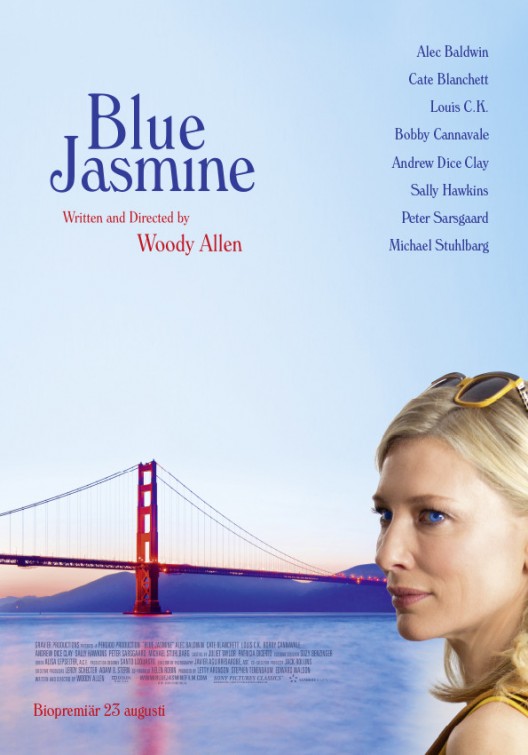
In this age of post-financial meltdown, some films have addressed this climate of uncertainty better than others. Enter Blue Jasmine. While not a direct examination of the financial crash, the dual narrative of watching the main character live a life of splendor unearned while returning to her current life as a former socialite, scrambling mentally and physically to rebuild herself, is both satisfying in a narcissistic way while being tragic and sad. Jasmine is multi-faceted as an aloof trophy wife, a blissfully unaware woman with a philandering husband that basically buys her ignorance, an enabler that watches her sister get taken advantage of and an empathetic figure that becomes exposed as a broken toy. You cannot help but watch her story with a combination of anger and sadness for her predicament.
It is likely that more and more films will touch on this subject from numerous angles as time moves forward. As one on the side of the divide at a clear disadvantage, I personally want to see a story that has a satisfying end for the obvious antagonist. The Wolf Of Wall Street worked in an "Aren't you jealous?" sort of way, but left some to be desired in terms of seeing consequences. In Blue Jasmine, I found myself wanting to laugh at her struggle and see her triumph in the face adversity equally.
Read: Lucifer Book Two by Mike Carey
Listen: Pete Holmes Nice Try, The Devil
Watch: 30 Rock
In nearly every Martin Scorsese film that serves as a cautionary tale on any level, the main character deals with ups and downs throughout before ultimately ending up leaving the viewer feeling as if a lesson was learned on some level. With The Wolf Of Wall Street, the lesson was absent. Or, if there was one, it was basically that if you have extreme wealth, you can buy your way out of trouble when it rears its ugly head.
I spent 180 minutes watching Leonardo DiCaprio and Jonah Hill's characters have sex with endless women, do mountains of illegal drugs, pillage the working class of their earnings through sleazy investments and see the world through grandiose means. In the end, when the entire charade was to come crashing down around them, they seemed to serve minimal resort prison time before re-entering society to regain their lost wealth on a speaking tour on how to get rich. If one wants payoff for seeing someone behave badly, it never arrives. Otherwise, it felt like a stylized Behind The Music for scam artists.
In this age of post-financial meltdown, some films have addressed this climate of uncertainty better than others. Enter Blue Jasmine. While not a direct examination of the financial crash, the dual narrative of watching the main character live a life of splendor unearned while returning to her current life as a former socialite, scrambling mentally and physically to rebuild herself, is both satisfying in a narcissistic way while being tragic and sad. Jasmine is multi-faceted as an aloof trophy wife, a blissfully unaware woman with a philandering husband that basically buys her ignorance, an enabler that watches her sister get taken advantage of and an empathetic figure that becomes exposed as a broken toy. You cannot help but watch her story with a combination of anger and sadness for her predicament.
It is likely that more and more films will touch on this subject from numerous angles as time moves forward. As one on the side of the divide at a clear disadvantage, I personally want to see a story that has a satisfying end for the obvious antagonist. The Wolf Of Wall Street worked in an "Aren't you jealous?" sort of way, but left some to be desired in terms of seeing consequences. In Blue Jasmine, I found myself wanting to laugh at her struggle and see her triumph in the face adversity equally.
Read: Lucifer Book Two by Mike Carey
Listen: Pete Holmes Nice Try, The Devil
Watch: 30 Rock


Comments
Post a Comment